INSIGHTS
20 practical ways to reuse your film, brochures and website
A lot of companies invest in strong communication materials, only to use them once and move on. But that’s a missed opportunity. This blog post shows how content repurposing can help you create consistency, clarity and more value from the content you already have.
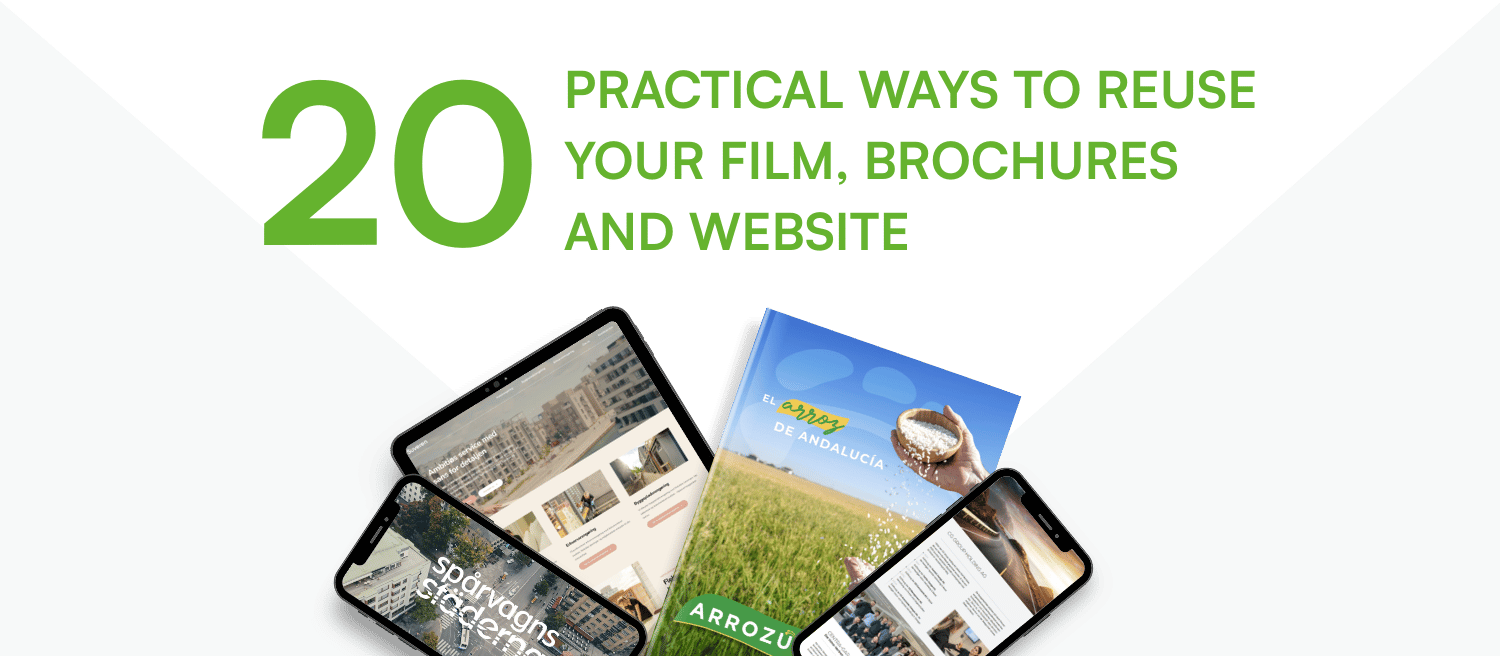
Most communication packages include several solid building blocks: a film, a website and a brochure, maybe both interactive and printed. Each element is well thought out and carefully produced.
But what happens after they‘ve been published?
Too often, these materials are used once and then left to stand alone. A film lives on the frontpage. A brochure is sent once. And the pressure to create something new quickly returns.
This is where content repurposing comes in.
Not as a quick marketing trick, but as a way to connect your materials and make better use of what you’ve already invested in. Instead of constantly producing new content, you reuse and adapt your existing assets across different situations and touchpoints.
That creates more consistency, clearer messaging and more value from the same effort.
In the sections below, you’ll find concrete examples of how to repurpose your film, brochures and website in practice.
One professional film – multiple strategic roles
A lot of companies treat their film as a single-use item. Publish it once, embed it on the frontpage and move on. But here’s the thing – one film can play several strategic roles.
Here are five concrete ways to use it:
- Strengthen your frontpage
Place the film prominently on your frontpage or key landing pages to explain who you are within seconds. - Support your sales meetings
Send the film before a meeting to set expectations – or play selected parts during the meeting to clarify complex messages. - Create ongoing social content
Cut the film into short clips, stills or quotes and use them to guide people back to your website. - Improve onboarding and internal alignment
Use the film to introduce new employees to your company’s positioning and key messages. - Stand out at physical touchpoints
Show the film at trade shows, conferences or even in your reception area to make a stronger impression.
One film. Multiple touchpoints. More value from the same investment.
Interactive and printed brochures as supporting layers
Brochures are often seen as simple information carriers. But they actually work best as supporting layers in a broader communication setup.
Here are a few ideas on how you can repurpose interactive and printed brochures to get the most out of them.
Interactive brochures – use them to deepen the dialogue
- Send it before meetings
Share your interactive brochure in advance so the conversation can focus on specific needs instead of basic information. - Use it live during sales presentations
Click through relevant sections together to guide the dialogue and adjust the focus based on questions. - Link to it from your website
Add the brochure to product or service pages to give visitors the option to explore more details. - Include it in your e-mail signature
Make it easy for potential customers to access in-depth information after any conversation. - Turn sections of it into social media content
Highlight one key benefit or section at a time and link back to the full brochure.
Instead of being used just once, your interactive brochure becomes a flexible sales and marketing tool.
Printed brochure – use it where physical presence matters
- Use it to support face-to-face meetings
Hand out a printed brochure during meetings so key messages don’t disappear once the conversation ends. - Leave it behind after events
At trade shows or workshops, a brochure becomes a tangible reminder of your company. - Bring it into recruitment conversations
Give candidates something concrete that explains your company, culture and values. - Place it in your reception area
Let visitors explore your services while they wait. - Share it through partners
Distribute brochures through partners and local channels to extend your reach.
When print and digital support the same message, they reinforce each other instead of competing.
Your website as the strategic hub
If content repurposing has a center, it’s your website.
Your website will often act as the base everything else points to. Films, brochures, social media posts and presentations all lead people back to a place where the full story is available.
This doesn’t mean your website needs constant rebuilding. It means using it strategically.
Here are situations where guiding people to your website creates value:
- After a first conversation
Instead of repeating everything, send them to a relevant service page or case story that explains it clearly and consistently. - Before a sales meeting
Share a specific landing page or case in advance so the meeting can focus on real needs instead of basic information. - When answering recurring questions
Direct customers to a relevant page instead of rewriting the same explanation every time. - After events or presentations
Send participants to a tailored landing page that supports the next step. - When prospects compare you to competitors
- Guide them to pages that clearly explain your approach, process or differentiators. Instead of leaving the comparison to guesswork, let your website show what sets you apart – in your own words.
Your website creates value when it supports real decisions – not just when it exists.
Making content repurposing a habit – not a one-off task
We experience over and over again how companies end up treating content repurposing as a one-off exercise. But why not exploit your materials to the fullest?
Our goal with this blog post is to encourage you to start making content repurposing a habit. A habit that’s built into how you plan and use communication.
A few simple practices help:
- Think about reuse already when planning new materials.
- Ask: Where else does this message make sense?
- Start with one or two assets at a time.
- Keep a simple overview of what exists and how it’s used.
You don’t need complex systems. Small routines are often enough to create momentum and consistency.
And remember, content repurposing isn’t about making you work harder to produce more materials. It’s about making your current materials work harder for you.
Other insights like this
Dive into some of our other insights and find inspiration for your marketing efforts.

20 creative content repurposing techniques for maximum impact
No need to reinvent the wheel. You can transform your content into new formats, settings, channels, shapes and sizes to make the most of your time and resources. But where do you start? Take a look at these 20 creative techniques that can help you reshape your existing content into something fresh and exciting while […]
Read more
5 strategies for memorable interactive marketing content
How do you stand out from the crowd when basically everyone is fighting for your target group’s attention? You turn on the stove to fire up your interactive marketing activities. Let’s dig into these 5 interactive marketing initiatives to boost engagement. 1. Make the user experience personal Take your website – or just a single […]
Read more
How to make the most out of your content marketing
You spend a lot of time making all of this great content. Perhaps you send it out in a newsletter and share it on Social Media (SoMe). But then, nothing happens with it – ever again. What if some of your followers missed this epic content? Or the newsletter was forwarded directly into the trash […]
Read moreLet’s connect
Follow us on LinkedIn to stay connected. Gain valuable insights to take your marketing efforts to the next level. And stay up-to-date on new opportunities for career growth.