INSIGHTS
5 mini exercises to align your internal and external communication
If your sales team describes your company differently than your website and/or other marketing materials, you have a problem. But don’t worry – you can fix that. Dive into this blog post and get 5 practical, hands-on exercises to spot mismatches and realign your internal and external messages.

Aligning your internal and external communication is simply the habit of ensuring the story you tell inside your company matches the story you tell the world. Your website, brochures, sales presentations and other marketing materials only represent your brand on the surface. The rest comes from your people.
How? From the way they speak about your company. The way they describe your values. The way they answer everyday questions.
But when internal and external messages don’t align, customers become confused. One moment they read one thing, the next they hear something different. And here’s the problem: Confusion is the enemy of trust.
And when there is no trust… well, who wants to buy or collaborate with someone they don’t trust? No one. That’s why alignment between internal and external communication is so important.
So how do you figure out whether there’s a mismatch between your internal and external communication? Look no further – we’ve gathered a quick self-audit you can run yourself right here 👇
REALITY CHECK
Exercise 1: Check for overall common grounds
Start with this quick mini audit to detect if you’re all on common ground or if there are signs of internal-external mismatches. It’s hands-on and practical – so no preparation needed.
Use this simple step-by-step guide to check for common ground:
- Pick 3-5 colleagues.
- Ask them: “How would you explain what we do and why it’s valuable – in one minute?”
- Write down what they say.
This is a quick but highly effective test to perform. Why? Because when you use this input for exercise 3, it almost always reveals where communication has drifted (if that’s the case).
Exercise 2: Reality-check with customer-facing colleagues
Your customer-facing teams know your target groups best. They hear objections, questions and reactions long before they show up in your analytics.
Exploit that by running this practical “frontline test”:
- Pick 3-5 colleagues from sales and/or support.
- Ask them:
- “What are customers asking about now that they didn’t ask 6 months ago?”
- “Which benefits or features make customers react positively?”
- “What objections appear most often – and how do you answer them?”
- Write down what they say.
This test reveals the gaps between your marketing claims and real-life objections. But remember, you’re looking for patterns, not perfect wording. When similar questions and objections show up across multiple colleagues, you’ve found your priority areas.
Exercise 3: Audit your materials from a customer’s point of view
This is the comparison step. So, gather your notes from exercises 1 and 2, because exercise 3 helps you identify whether it’s your materials or your internal communication that needs updating.
Try this 5-step material check:
- Read your website’s front page out loud.
- Read key parts of your brochure, sales presentations or other marketing materials.
- Compare it with the wording used by your colleagues in exercises 1 and 2.
- What to compare:
- Are they describing the same core value(s)?
- Are they using the same terms you use externally?
- Are they emphasizing the same strengths you promote in your materials?
- Are employee explanations simpler or more complicated than your external messaging?
- Are internal teams making promises that your materials don’t support (or vice versa)?
- Mark where your language, claims or priorities don’t match.
- Decide whether your external materials or internal communication should be updated.
- Hint: Consider if:
- Your team is already talking about new customer needs ➡️ Update your materials to match.
- Your materials are current, but the team isn’t using them ➡️ Reinforce the message internally.
Now you have “diagnosed” where the misalignments exist and decided where updates should be made – high five 🙌. Now let’s take it a step further. Follow the next exercises to set up simple processes that help you catch future misalignments between internal and external communication before they create too much confusion.
ONGOING ALIGNMENT
Exercise 4: Create a shared message cheat sheet
To make sure that everyone is on the same page internally, a shared message cheat sheet is the way to go. But pause a second before you turn your heel on this – assuming it involves looong and boring branding documents. It doesn’t!
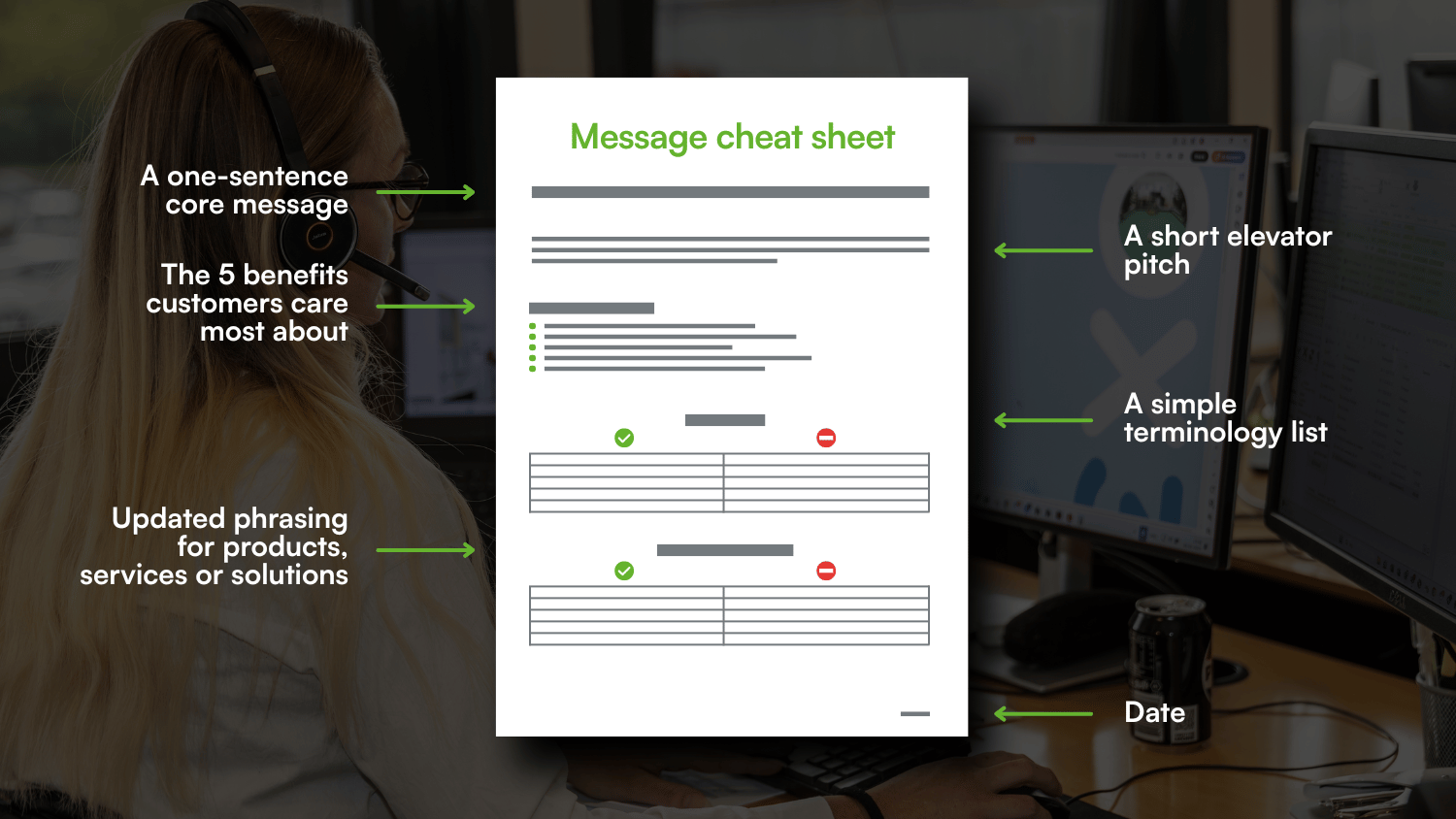
A message cheat sheet is a simple tool your team can use every day to stay consistent. It’s short and to the point to ensure it’s actually useful for your team.
Here are some suggestions on what to include in your message cheat sheet:
- A one-sentence core message.
- A short elevator pitch.
- The 3-5 benefits customers care most about.
- A simple terminology list.
- Updated phrasing for products, services or solutions.
Share it with the whole team and take 5 minutes to walk through it in a meeting. This cheat sheet helps everyone describe your organization in the same way – without scripting or restricting them.
Tips for keeping it alive:
- Use it as part of onboarding new colleagues.
- Keep it to one page.
- Put it somewhere everyone can find (not buried in folders).
- Refresh it every time you update your materials or priorities.
Exercise 5: Build alignment into your monthly workflow
This step can make a world of a difference (so don’t skip it). This is where you turn a one-off project into an ongoing alignment habit. And it makes your job of keeping things aligned so much easier.
Set up these simple monthly routines:
- Add a 5-minute “message sync” to your team meetings.
- Encourage teams to flag mismatches as they spot them.
- Ask sales once a month: “What are customers saying lately?”
- Update colleagues when marketing materials change.
- Review one piece of material each month instead of waiting a year.
These micro-routines prevent small drifts from becoming big inconsistencies – and save you from a ton of work down the line.
Start strengthening your brand from the inside
There you have it. Hands-on tips for getting your internal and external communication alignment ducks in a row (so to speak).
Once you make this part of your routine, you’ll realize just how simple alignment really is. You just have to make sure that the story you tell internally matches the story you tell externally. And when your team and your materials reinforce the same message, customers feel it.
And yes, that’s when trust grows faster.
Other insights like this
Dive into some of our other insights and find inspiration for your marketing efforts.

4 website tips: Boost website traffic and keep visitors engaged
This blog post provides you with 4 basic tips for how to drive more visitors to your website and inspire them to stay there longer. The longer time that visitors stay on your site, the more they come to know and trust your brand. In the long run, their trust in you can lead to […]
Read more
5 strategies for memorable interactive marketing content
How do you stand out from the crowd when basically everyone is fighting for your target group’s attention? You turn on the stove to fire up your interactive marketing activities. Let’s dig into these 5 interactive marketing initiatives to boost engagement. 1. Make the user experience personal Take your website – or just a single […]
Read more
How to make the most out of your content marketing
You spend a lot of time making all of this great content. Perhaps you send it out in a newsletter and share it on Social Media (SoMe). But then, nothing happens with it – ever again. What if some of your followers missed this epic content? Or the newsletter was forwarded directly into the trash […]
Read moreLet’s connect
Follow us on LinkedIn to stay connected. Gain valuable insights to take your marketing efforts to the next level. And stay up-to-date on new opportunities for career growth.